

Celebrating 50 Years of Impact: Insights from Former NAHQ President Anna Marie Butrie
June 24, 2026Share:


As NAHQ celebrates its 50th anniversary, we have a unique opportunity to reflect on the leaders, ideas, and milestones that have shaped healthcare quality over the past five decades. Throughout this anniversary year, we’ll be welcoming perspectives from former presidents of the NAHQ Board of Directors -- leaders whose vision, service, and commitment helped guide our association through periods of significant change and growth.
We begin these reflections with Anna Marie Butrie, MSN, MPH, FNAHQ, CPHQ, whose distinguished career exemplifies the evolution of healthcare quality and the enduring importance of standards, workforce capability, and continuous improvement. Her journey offers valuable lessons for the future.
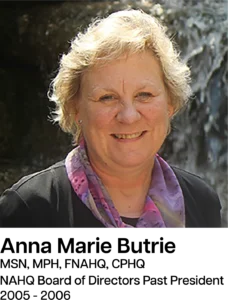 Anna Marie began her career as a NICU and Pediatric ICU nurse before joining an emergency transport team—roles that shaped her instinct for precision, teamwork, and an understanding of what “good” truly looks like at the bedside. After graduate school and a yearlong administrative residency at an academic medical center, she stepped into leadership with responsibility for admissions, utilization review, and preadmission programs. From there, she built quality programs across a large for-profit health system, preparing multiple organizations for Joint Commission surveys and establishing the infrastructure that makes quality repeatable.
She ultimately concluded her career in a multi-health system leadership role, overseeing program management, productivity improvement, strategy development, and the creation of an innovation program.
Anna Marie’s journey is a masterclass in how standards, capability, and execution shape outcomes, not just once, but consistently over time. Her reflections in this month’s Q&A remind us that quality is built, not claimed, and that the most meaningful legacy is what is reliably delivered for patients because of the systems and leaders who came before us.
Explore her insights on career origins, closing blind spots, and the capabilities leaders must build now and for the future.
(Q) When you think back to how you entered quality and safety, what experiences most shaped your interest in the profession? What was your ultimate motivation?
(AMB) My initial interest in quality began in graduate school, where I took a course on quality assurance. My interest continued to grow during a yearlong administrative residency program, in which I was responsible for developing an administrative nursing manual in preparation for an accreditation survey. While working for a large for-profit organization, I had the opportunity to follow surveyors across multiple organizations, which was extremely educational. This eventually led to an interest in continuous quality improvement and helping organizations with productivity improvement, change management, and the formation of new, cost-effective health systems.
I also had the honor of being appointed as an Innovation Advisor to the Center for Medicare and Medicaid Innovation. In that role, I had the opportunity to see how innovation incorporates many quality management and improvement techniques.
My ultimate motivation was to lead organizations in providing high-quality, cost-effective care.
(Q) How did you first become engaged with NAHQ? Any notable memories from your leadership experience?
(AMB) My involvement began as an editorial review board member for JHQ. From there, I participated in multiple task forces, including the development of the Guide to Quality Management, and taught multiple CPHQ preparation courses. The team lead for JHQ, as well as my manager at the time, encouraged me to run for Region 2 Representative, and to my surprise, I was elected. Eventually, I was elected Secretary/Treasurer and then President-Elect.
I served as President of NAHQ in 2005–2006, and our focus at that time was moving the organization from “good to great.” During that time, I also became a NAHQ Fellow. Over the years, I have had the opportunity to meet and work with some amazing volunteers and have developed lifelong friendships that I continue to cherish.
(Q) Early in your journey, what were your blind spots? What helped you identify them and build competencies to overcome them?
(AMB) It is important to recognize who has power in an organization, and you need to pay as much attention to those who have indirect power as those who have direct power. Sometimes the former can yield greater results, but it is important that you bring both groups with you on your improvement journey.
Equally important is asking a great deal of questions: How are issues identified? How do we fix them? What needs to be in place for success?
(Q) As you moved into senior leadership, how did your focus shift from building your own skill set to developing the competency of an entire team?
(AMB) As I moved into senior leadership, I realized my role was no longer just about developing my own expertise, it was about creating the conditions for an entire team to succeed. I recognized that a leader is only as strong as the team around them, and that high-performing teams require more than individual talent; they need a shared foundation of competencies, expectations, and language.
That is why I became increasingly focused on helping team members grow in both their areas of expertise and their areas of interest, while also ensuring everyone was aligned around common standards for success. When teams understand the capabilities needed to perform effectively, they can better collaborate, identify development opportunities, and leverage one another’s strengths.
A leader does not need to have all the answers; a team with varied competencies can, in most cases, develop a stronger solution together.
(Q) What do you value most about working in quality and safety, especially on hard days when progress feels slow or uneven?
(AMB) I value data, consistency of approaches, and people who can think outside the box when creating solutions. A valuable solution is one that can be spread across the organization and is not simply a one-time fix.
It is important to recognize that quality and safety are the backbone of a financially strong organization and a trusted reputation.
As we celebrate NAHQ’s 50th anniversary, Anna Marie’s story reminds us that progress in healthcare quality is built through the dedication of leaders who challenge assumptions, strengthen systems, and invest in the next generation. Her impact is also deeply personal to me. I first met Anna Marie in 2005 when we worked at the same organization as she began her NAHQ presidency. Coincidentally, it was also my first year working in healthcare quality. Through her leadership and encouragement, I joined NAHQ and learned about the CPHQ credential, an introduction that would shape my own professional journey in healthcare quality. We are grateful for her contributions to NAHQ and the profession, and we look forward to sharing more perspectives from the leaders who have helped shape our past and continue to inspire our future.
April Taylor, FACHE, CMQ/OE, CLSSBB, CPPS, CPHQ
NAHQ President
There is a roadmap to healthcare Quality excellence. NAHQ can help you follow it.
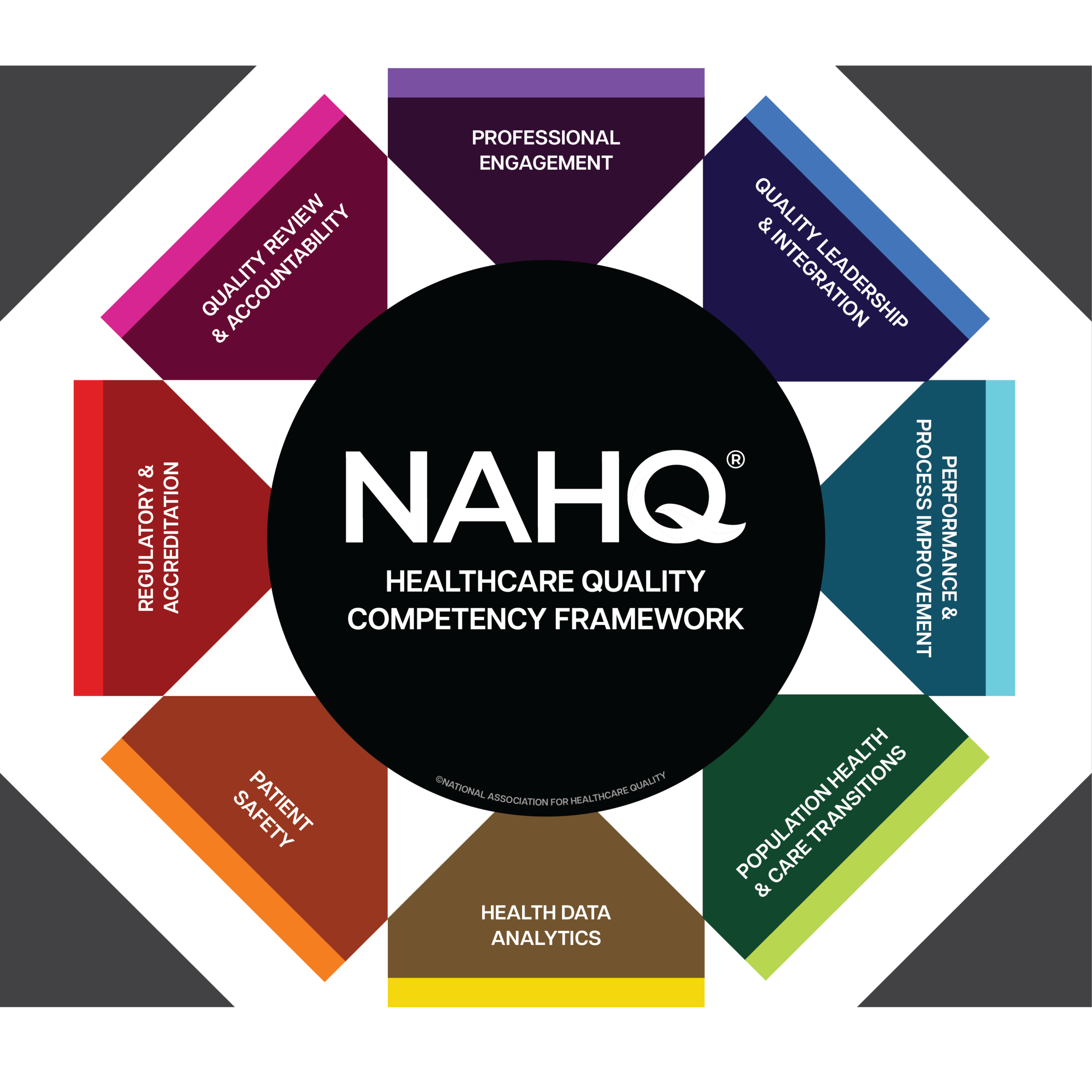
The NAHQ Healthcare Quality Competency Framework™ serves as the industry-standard, defining the Quality Safety competencies, skills and behaviors required to advance Quality & Safety excellence across the healthcare continuum.
This expert-created, data-informed framework is continuously validated and updated by NAHQ to ensure it provides the most up-to-date information, guiding professionals, organizations, and the healthcare industry to create a competent, coordinated workforce prepared to deliver healthcare excellence.